Leadership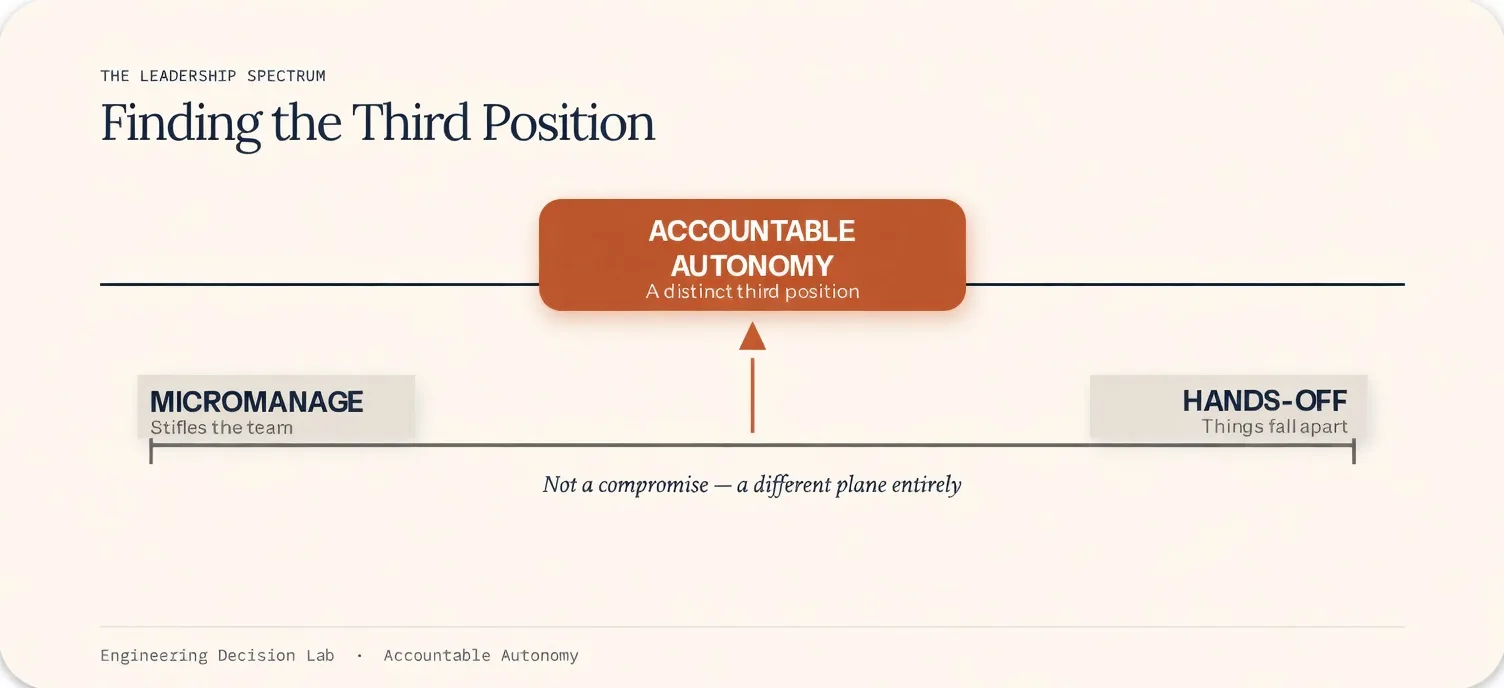
Leadership
Accountable Autonomy: The Leadership Philosophy That Actually Works
After years leading engineering teams, I’ve found the answer to the micromanage-vs-hands-off debate isn’t choosing a side — it’s building a culture of accountable autonomy. High expectations, real ownership, genuine trust, and decisive action when things go wrong.
2–4 min read
Key Takeaways
- Autonomy only works when paired with clear expectations and real accountability
- Capable people deserve to be trusted — and held to a high standard
- Letting underperformance sit doesn’t serve anyone on the team
- Accountable autonomy is a daily practice, not a one-time policy
The False Choice
There's a persistent misconception in engineering leadership: you have to choose between being hands-on and being hands-off. Micromanage and you stifle your team. Step back too far and things fall apart.
The answer isn't choosing between those two extremes — it's rejecting the premise. What I've built my management approach around is accountable autonomy: not a compromise between micromanagement and neglect, but a third position entirely.
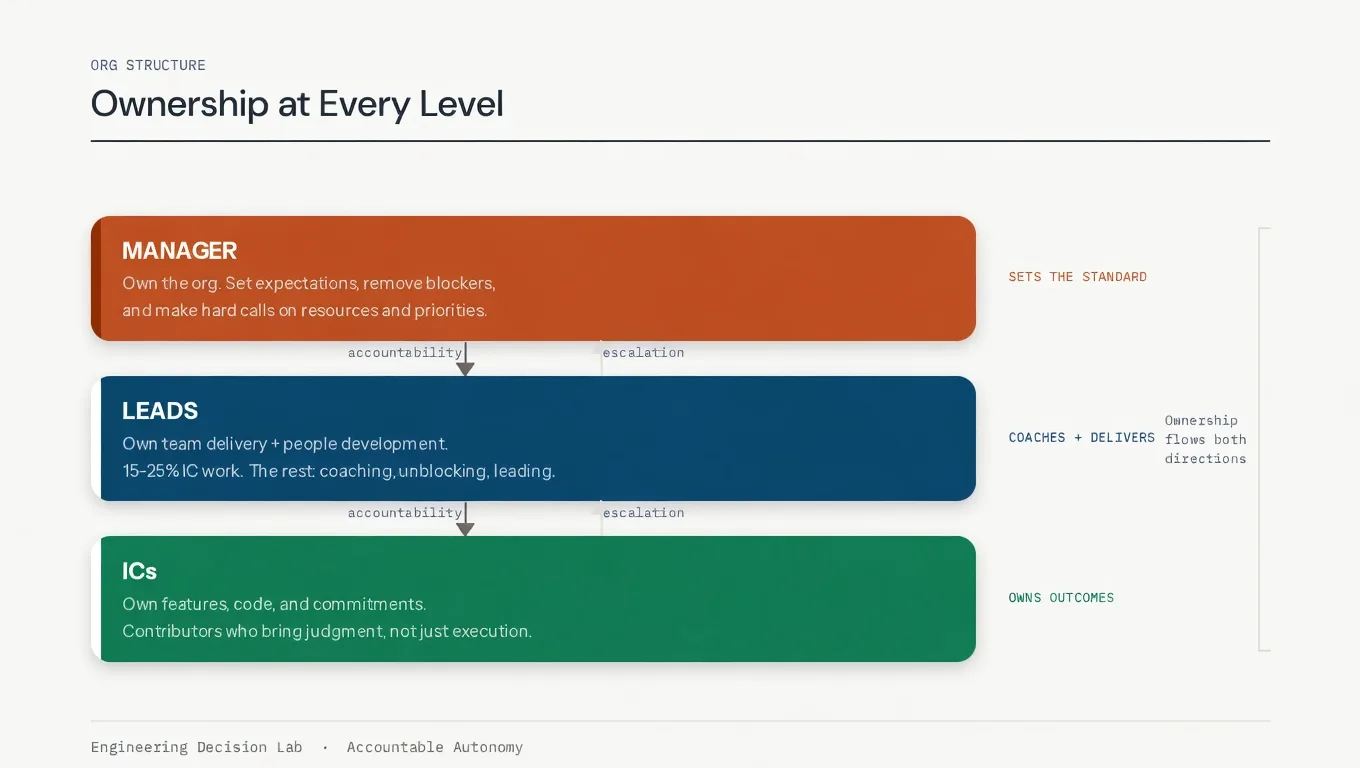
The premise is simple. We hire talented, well-compensated engineers because they are capable of owning outcomes. My job isn't to tell them how to do their work — it's to make sure they know what success looks like, have what they need to get there, and are held to that standard.
What It Actually Looks Like
Accountable autonomy shows up in specific behaviors every week.
It means setting expectations clearly upfront — not vaguely hoping people figure out what good looks like over time. It means 1:1s that are honest in both directions: what's working, what isn't, where someone is growing, where they're stuck. It means giving credit openly and specifically when someone does great work — recognition matters as much as correction.
It also means trusting people to figure things out while staying genuinely available when they need support. My team should never feel watched — but they should always feel like they can bring me a hard problem and get real engagement, not just delegation back to them.
Autonomy without accountability produces complacency. Accountability without autonomy produces resentment. The combination — high expectations, real ownership, genuine trust — is what brings out the best in people.
The Accountability Part Has Teeth
This is not a soft philosophy.
We pay engineers well. In return, we expect performance at the level we hired for. If someone isn't delivering — if commitments aren't being kept, if the standard isn't being met — we address it quickly and directly. We don't let it sit. We have the conversation, set the expectation, give a reasonable runway, and if improvement doesn't come, we move toward an exit.
I had a senior engineer on one of my teams who was technically capable but consistently missing sprint commitments and deflecting feedback. After giving it some time, I had the direct conversation: here's the pattern I was seeing, here's what needed to change, and here's the timeline. When improvement didn't come, we moved toward a transition. It wasn't comfortable — but the team noticed, and the standard became clearer for everyone.
This isn't harsh — it's respectful. Letting underperformance linger is actually the unkind thing to do. It's unfair to the rest of the team, it signals the standard doesn't matter, and it ultimately doesn't serve the underperformer either. Decisive accountability tells people that their work matters and the standard is real.
Series
People-First Leadership · Part 5
Previous · Part 1
Why I Don't Do Technical Interviews for Senior Engineers
Previous · Part 2
Why I Let People Struggle — And When I Step In
Previous · Part 3
People Are Your Most Valuable Asset — And Most Leaders Don't Actually Believe That
Previous · Part 4
The Documentation Discipline Every Engineering Leader Needs